
How solar water pumping works
A solar water pumping system turns sunlight into moving water: no fuel deliveries, no grid connection, no electricity bill. It is the standard way to bring water to farms, livestock, villages and lodges located beyond the last power line. This guide explains how the technology works, what the main components do, and how to choose the right system architecture.
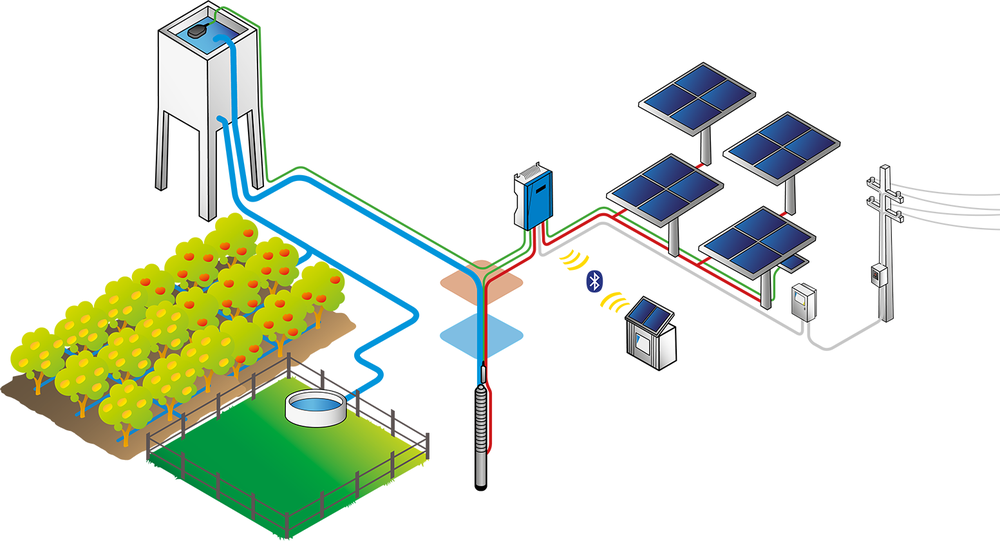
From sunlight to flowing water: the principle
Solar panels produce direct current (DC) as soon as light reaches them. That current feeds a motor drive, either built into the pump itself or installed as a separate solar inverter, which converts the available power into the voltage and frequency the pump motor needs at that moment.
The key function inside every good solar drive is Maximum Power Point Tracking (MPPT). Cloud cover, sun angle and panel temperature change from minute to minute, so the drive re-measures the array output several times per second and continuously adjusts the pump duty point to harvest the maximum available power. In practice the pump simply speeds up as the sun rises, slows down as clouds pass, and stops at night.
Sun in, water out
A solar-only pumping system has no fuel costs and no energy bill for its entire service life; operating costs come down to keeping the panels clean. Choose a hybrid setup and the generator fuel becomes the one energy line left, spent only when the sun falls short.
The building blocks of a solar pumping system
- Solar array and mounting structure. Sized to the daily water demand, the head and the local solar irradiation. Fixed-tilt structures are the norm for water supply.
- Controller or solar inverter. The brain of the system: MPPT, motor protection and system inputs (level switch, pressure switch, remote control).
- The pump. A submersible borehole pump for groundwater, or a surface pump for rivers, ponds and tanks.
- Storage tank. Water pumped while the sun shines is stored for the evening and early morning, and distributed by gravity or by a small booster.
- Protections. Dry-running cut-out, overload and over-temperature protection, and a level switch that stops the pump when the tank is full.
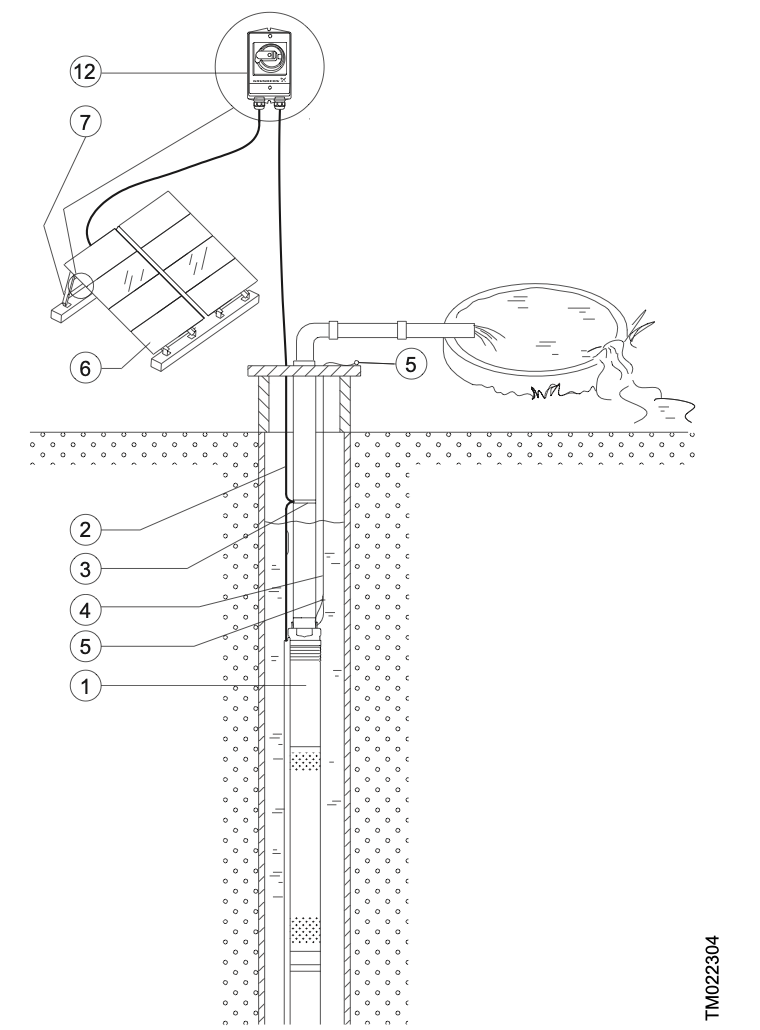
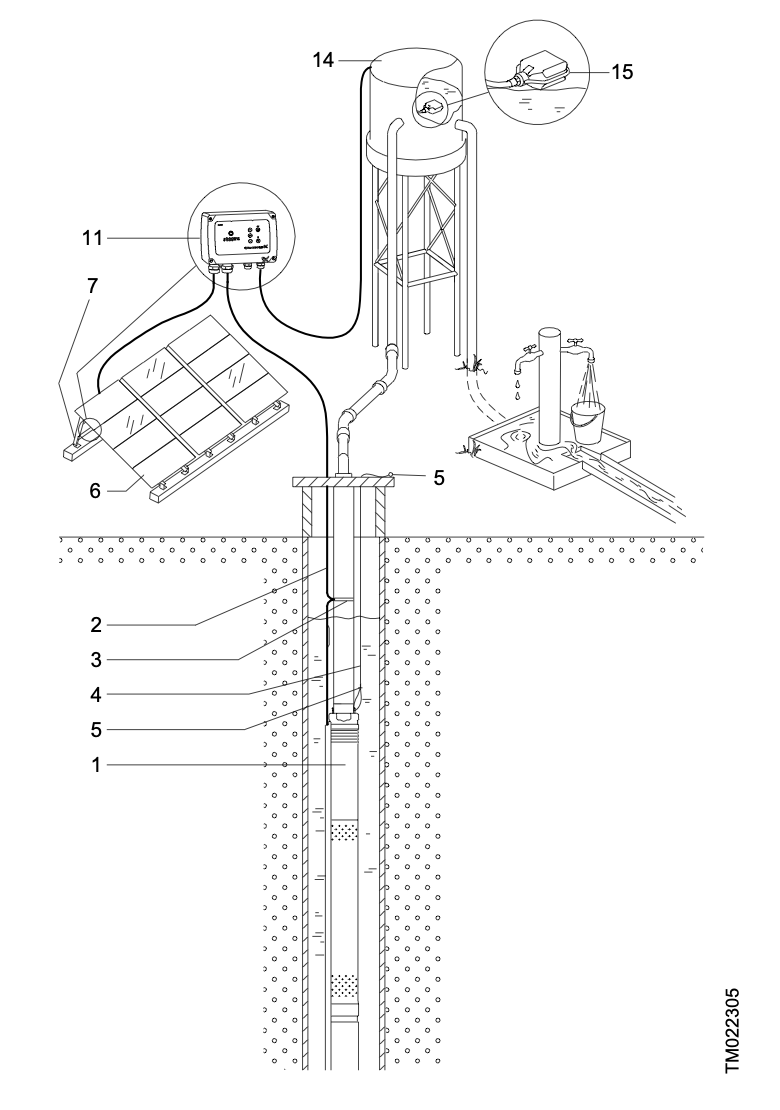
Integrated electronics or external solar inverter?
Compact systems place the drive electronics in the pump itself or in a dedicated controller next to the array. The Grundfos SQFlex is the best-known example: its permanent-magnet motor accepts anything from 30 to 300 VDC or 90 to 240 VAC, and its helical rotor version keeps delivering water from deep boreholes even under a weak morning sun. The LORENTZ PS2 range follows the same philosophy with a separate MPPT controller beside the array.
Large-scale pumping takes the opposite route: a standard three-phase pump, such as a Grundfos SP borehole pump or a CR multistage surface pump, driven by an external solar pump inverter. The Grundfos RSI covers 1.5 to 250 kW, with the enclosure rating depending on the version, and the ABB ACQ80 plays the same role for larger custom systems. This is how pivots, large drip blocks and village networks are powered.
Store water, not electricity
Batteries are rarely the right answer for water supply. An elevated tank stores the day's production at a fraction of the cost, never wears out, and delivers water all night by gravity. A float or level switch connected to the pump controller fills the tank automatically whenever the sun allows it.
900 W of panels, 5,000 litres per day
A concrete example of what that means: a single SQFlex pumping from 40 m below ground with a 900 W array delivers up to 5,000 litres of safe water daily to an overhead tank, enough to serve a community of 18,000 people through water points.
Cloudy weeks, nights and hybrid operation
Because the drives accept AC as well as DC, a solar pumping system is never locked to the sun. A changeover switch box, such as the Grundfos IO 101 in SQFlex systems, lets a diesel or petrol generator take over during long overcast periods or exceptional demand, then hands control back to the array automatically. On LORENTZ PS2 systems the same role is played by the PowerPack accessory, covered in our PS2 system guide. Where a grid connection exists, the same flexibility allows night pumping on mains power.
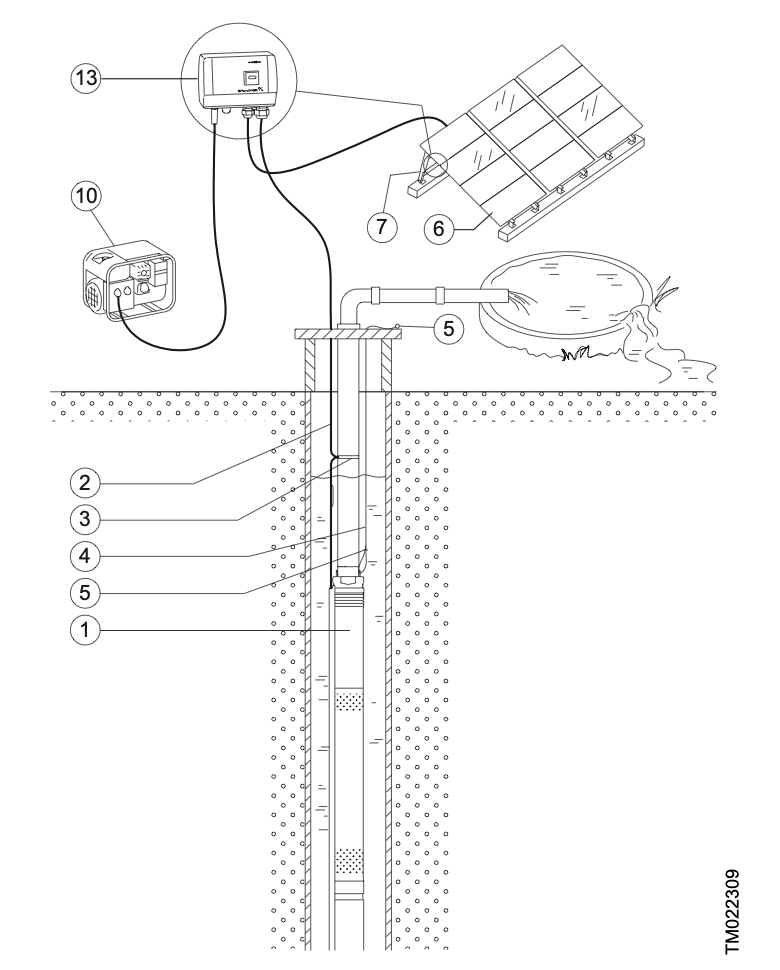
What about maintenance?
A well-sized solar pumping system is remarkably undemanding. Panels are cleaned periodically, and the pump protections do the rest: the dry-running electrode stops the pump if the water level falls, overload protection reduces speed instead of burning the motor, and over-temperature and voltage protections handle unstable supplies. There is no fuel to transport, no oil to change, and no starter equipment to service.
Where solar pumping fits
The same building blocks serve very different jobs. Pick the guide that matches yours:
Reference solar pumping equipment
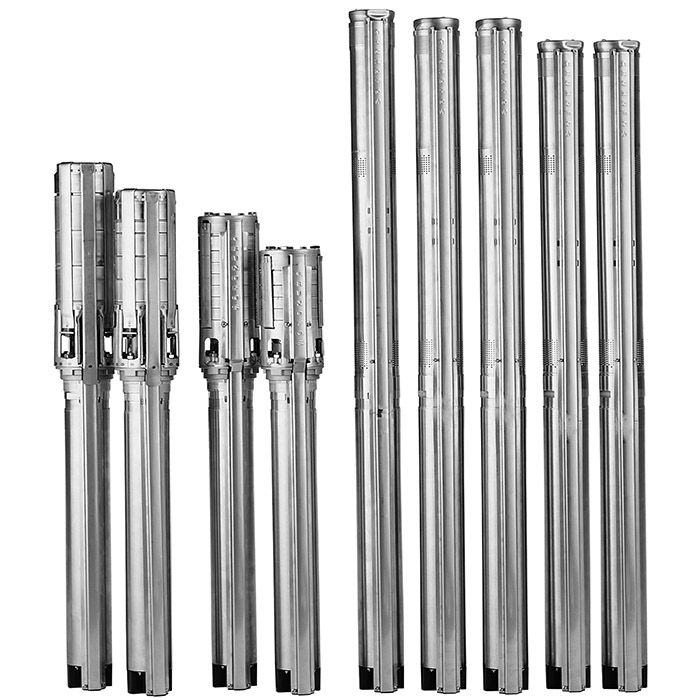 Grundfos SQFlex
Solar submersible pump, up to 250 m head, 30-300 VDC / 90-240 VAC
Grundfos SQFlex
Solar submersible pump, up to 250 m head, 30-300 VDC / 90-240 VAC
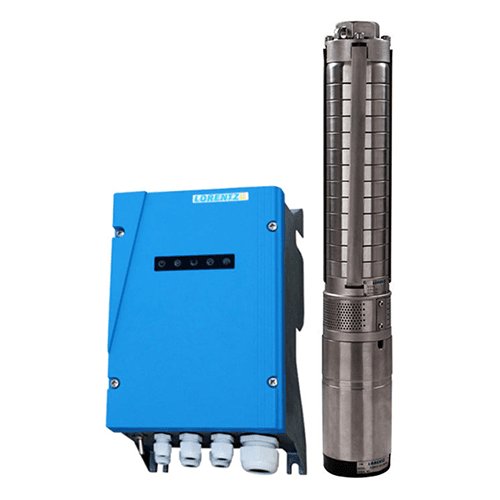 LORENTZ PS2
Solar pump systems with dedicated MPPT controller, boreholes and surface
LORENTZ PS2
Solar pump systems with dedicated MPPT controller, boreholes and surface
 Grundfos RSI
Solar inverter 1.5 to 250 kW, for SP and CR pumps
Grundfos RSI
Solar inverter 1.5 to 250 kW, for SP and CR pumps
Frequently asked questions
Does a solar pump work on cloudy days?
Yes, at reduced flow. The MPPT drive harvests whatever power the array produces, so the pump keeps running slower under clouds. Helical rotor pumps such as the SQFlex are particularly good at delivering water from deep boreholes with minimal sunlight. For long overcast periods, a storage tank and an optional generator changeover cover the demand.
Do I need batteries for a solar water pump?
Usually not. Storing water in an elevated tank is cheaper and more reliable than storing electricity in batteries. The tank feeds taps, troughs or drip lines by gravity at night. Batteries remain an option for specific cases, and SQFlex systems accept battery supply from 30 to 300 VDC.
What size solar array does my pump need?
It depends on three inputs: the total head, the daily water demand and the solar irradiation at your location. Read our solar pump sizing guide, or send us your borehole data and we will size the complete system for you free of charge.
Can a solar pumping system run at night?
The pump itself stops without sunlight, but the system keeps supplying water from the storage tank by gravity. Where night pumping is genuinely required, the AC/DC compatible drives accept a generator or mains power through a changeover switch box.
Planning a solar pumping project?
SINES Export supplies installers, EPC contractors, NGOs and distributors worldwide. Send us your head, daily demand and location: our team returns a complete sized system with a wholesale quote.
Launch LE LAB Free sizing study