
Drip irrigation with solar pumps
Drip is the most water-efficient irrigation method, and it is also the one that pairs best with solar pumping: modest pressure, steady daytime flow, and a layout that scales from a market garden to a commercial orchard. This guide covers the design basics a solar drip project must get right: pressure, filtration, and the choice between direct pumping and a gravity tank.
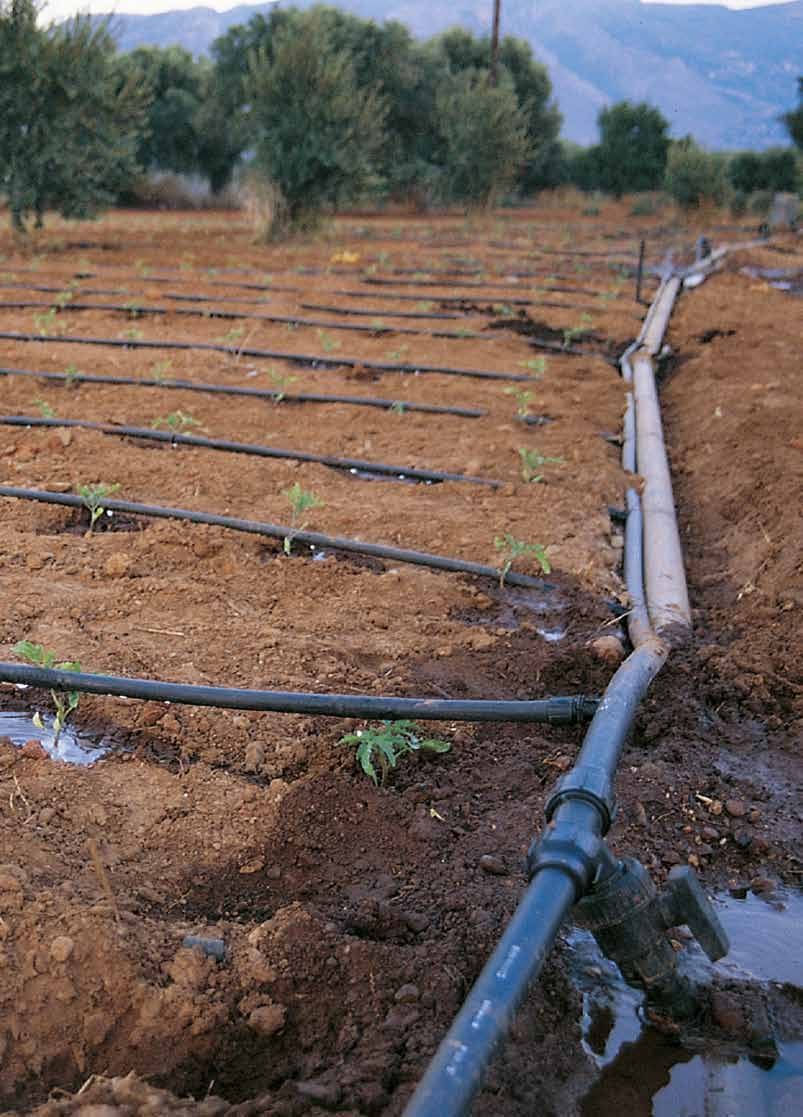
Why drip and solar work so well together
Drippers and emitters apply water slowly, plant by plant, which makes them the most water-efficient distribution hardware available. That slow, continuous demand is exactly what a solar pump produces: a steady flow that follows the sun through the day. There is no need for the big instantaneous flow a sprinkler network demands, so the pump and the array stay small for a given field.
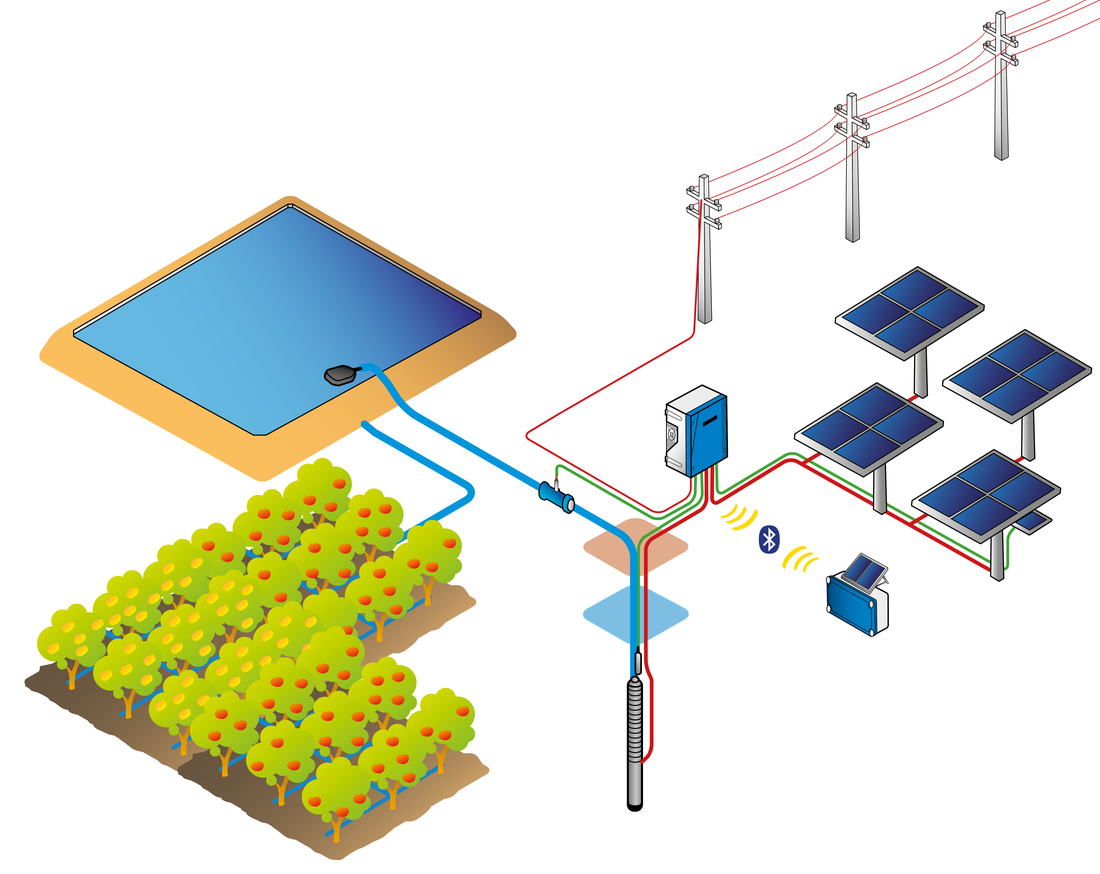
Drip systems also tolerate both operating modes of a solar installation: pressurised, with the pump feeding the laterals directly through a filter, or gravity-fed, from a tank filled during sunshine hours. Both are standard practice; the right one depends on your terrain and schedule.
Pressure: modest, but not optional
Standard emitters are designed to work at around 1 bar at the lateral, roughly 10 m of head, plus whatever the filter, the pipes and the terrain add upstream. Pressure-compensating emitters keep the flow uniform across slopes and long laterals, which protects the distribution uniformity of the whole block. Uniformity is the quiet driver of drip performance: when every plant receives the same volume, you irrigate to the real crop need instead of overwatering half the field to save the driest corner.
Filtration: the non-negotiable
Everything in a drip system passes through openings smaller than a millimetre. Sand, silt or organic matter will clog emitters block by block, and the failure is invisible until the crop shows it. Every solar drip design therefore includes filtration matched to the water source: screen or disc filters for boreholes with fine particles, media filters where surface water carries organic load, and a hydrocyclone ahead of the line when the well pulls sand. Remember the pump has its own limit too: above roughly 50 g/m³ of sand, the lifespan of any submersible drops considerably.
Two ways to power a drip block
- Direct solar pumping. The pump feeds the filter and the laterals while the sun shines. Simple and cheap, with irrigation naturally happening during the day. A pressure-regulated design keeps emitters in their working range as the sun varies.
- Tank plus gravity. The pump fills an elevated tank; the laterals run off the tank whenever you choose, including at dawn when evaporation is lowest. Every 10 m of tank elevation provides about 1 bar: a tank on a 10 to 15 m stand runs standard emitters without any booster.
Mixed layouts are common on farms: gravity for the daily schedule, direct pumping for peak season. The controller's level switch stops the pump when the tank is full, so the system runs itself.
Matching the pump to the block
- Market gardens and smallholdings: a compact solar pump with integrated electronics, such as the Grundfos SQFlex from a borehole or a LORENTZ PS2 from a well or river, covers the demand with a small array.
- Orchards and medium blocks: a Grundfos CR multistage pump boosts from the tank or the canal through the filtration station.
- Commercial estates: a three-phase SP borehole pump driven by a Grundfos RSI solar inverter feeds several blocks in rotation through automated valves.
Fertigation bonus: whatever the pump, a drip network is also the cleanest way to carry dissolved fertiliser exactly to the roots.
Block defined? Size the pump and array with LE LAB, free and instant.
Scheduling: irrigate to the root zone
Efficient drip scheduling follows the soil, not the calendar. The target is to wet the root zone and stop: pushing water past root depth feeds the water table, not the plant. Sandy soils take short frequent cycles, clay soils longer, less frequent ones. Because a solar system pumps every day for free, frequent short cycles cost nothing extra, which is exactly what most drip crops prefer.
Reference equipment
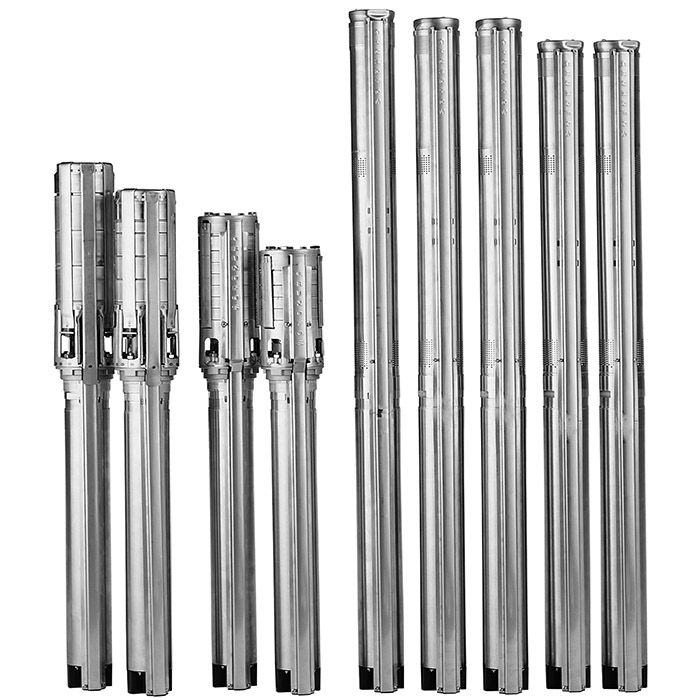 Grundfos SQFlex
Borehole to drip block or tank, integrated MPPT electronics
Grundfos SQFlex
Borehole to drip block or tank, integrated MPPT electronics
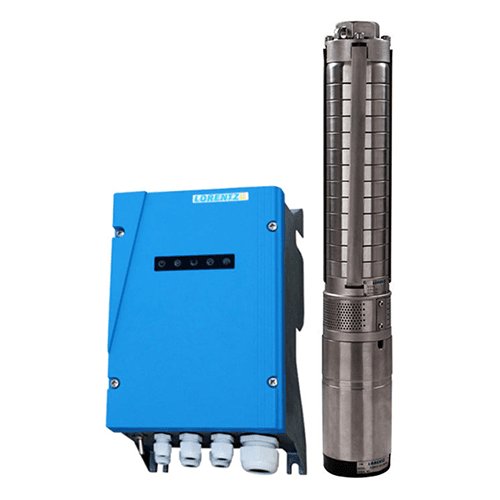 LORENTZ PS2
Wells, ponds and rivers, dedicated MPPT controller
LORENTZ PS2
Wells, ponds and rivers, dedicated MPPT controller
 Grundfos CR
Boost from tank or canal through the filtration station
Grundfos CR
Boost from tank or canal through the filtration station
Frequently asked questions
What pressure does drip irrigation need?
Around 1 bar at the lateral for standard emitters, plus the losses of the filter and pipes upstream. Pressure-compensating emitters hold their flow across a range of pressures, which keeps long laterals and sloped fields uniform.
Can drip run on gravity alone from a tank?
Yes. Roughly 10 m of tank elevation gives 1 bar, enough for standard emitters if the laterals are sized generously. The solar pump fills the tank during the day; the field irrigates whenever you open the valve.
Do I need filtration on clean borehole water?
Yes, always. Even visually clean groundwater carries fine particles that accumulate in emitters. A screen or disc filter is cheap insurance; sandy boreholes justify a hydrocyclone, both for the emitters and for the pump itself.
Is drip really worth it against sprinklers?
For row crops, orchards and vegetables, usually yes: drip is the most water-efficient method, needs the least pressure, and therefore the smallest solar array. Sprinklers keep the advantage on dense field crops and pasture; see our sprinkler and pivot guide.
Planning a solar drip project?
Send us the block size, the crop, the water source and the elevation. We size the pump, the array and the filtration, and return a complete wholesale quote.
Launch LE LAB Free sizing study