
Solar livestock watering systems
Livestock watering is the application solar pumping was born for: a modest daily volume, needed every single day, on land the grid will never reach. A small array, the right pump and a float switch replace the windmill, the fuel runs and the daily drive to check the trough. Here is how ranchers, farmers and game reserves set it up.
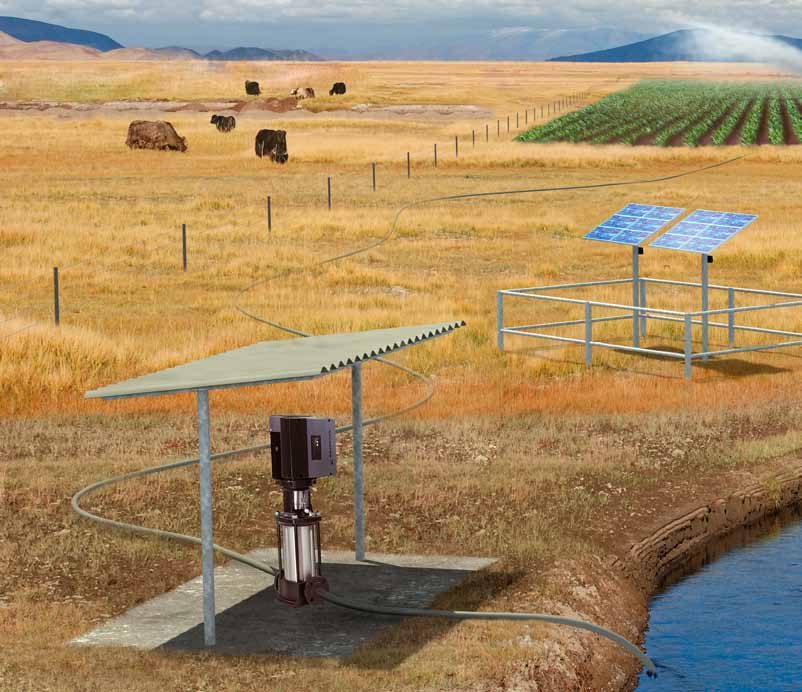
Trough or tank: the two layouts
- Direct to the trough. The pump feeds the watering station while the sun shines. Simplest possible system, best where animals drink during the day and the source is dependable.
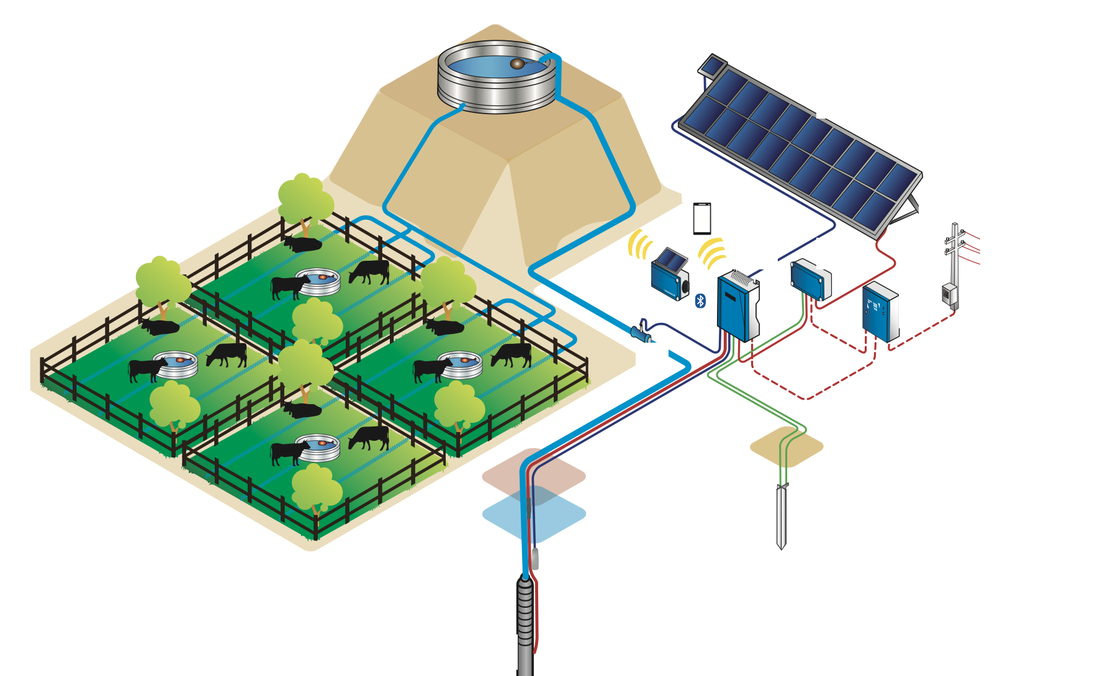
- Through a storage tank. The pump fills an elevated tank; the trough draws from it through a float valve whenever animals drink, day or night. The tank also buffers two or three overcast days, which is the margin a herd needs.
Most professional installations choose the tank. It decouples the drinking schedule from the sunshine, and it turns a cloudy week from an emergency into a non-event.
How much water does a herd need?
The LORENTZ livestock application guide publishes reference figures per animal and per day; multiply by the head count, and adjust for your climate and season:
| Animal | Water per day |
|---|---|
| Dairy cow in milk | 68 to 155 litres |
| Cow with calf | 50 litres |
| Two-year-old cattle | 36 to 50 litres |
| Ewe with lamb | 9 to 10.5 litres |
| Pregnant ewe or ram | 4 to 6.5 litres |
Herd counted? Size the matching solar pump with LE LAB, free and instant.
Two design rules follow. Supply must be fast: slow troughs create stress and competition in the herd, and animals that queue for water graze less. And troughs should sit no more than about 200 m apart, so the animals spend their energy grazing rather than walking to water. As a scale reference, documented systems range from a 0.6 kWp station delivering 20 m³ per day from 15 m to a PSk2-25 station delivering 400 m³ per day from 80 m with 33.6 kWp.
Small flows, big heads: the right pump profile
A watering point rarely needs large flow, but it often sits on a deep borehole. That profile, high head with low flow, is exactly what helical rotor solar pumps are made for: the Grundfos SQFlex helical rotor versions lift from as deep as 250 m and keep delivering water even under a weak morning sun, starting on minimal light. The LORENTZ PS2 HR range covers the same duty with its dedicated controller.
For shallow water or surface sources such as dams and ponds, small centrifugal solar pumps and floating intakes do the job with an even smaller array. Where a single high-yield borehole waters several paddocks, a three-phase Grundfos SP with a solar inverter feeds a network of tanks.
Automation: the system looks after itself
Two small components make a livestock system genuinely unattended:
- The level switch in the tank stops the pump when the tank is full and restarts it as the level drops. In SQFlex systems the CU 202 control unit handles this, and signals dry running, service needs and input power on its display.
- Dry-running protection guards the borehole itself: a water level electrode above the pump stops it if the level falls to the intake, then restarts it automatically once the well recovers. Weak boreholes stay safe without anyone watching them.
Game farms and conservation areas
Game reserves run the same systems with two particularities. Water points are scattered across huge areas, which means many small independent solar stations rather than one big network. And intakes often draw from surface water: floating pump installations in ponds and rivers are standard practice, keeping the intake off the muddy bottom. Solar suits conservation land for one more reason: no fuel transport and no oil anywhere near the waterhole.
Reference equipment
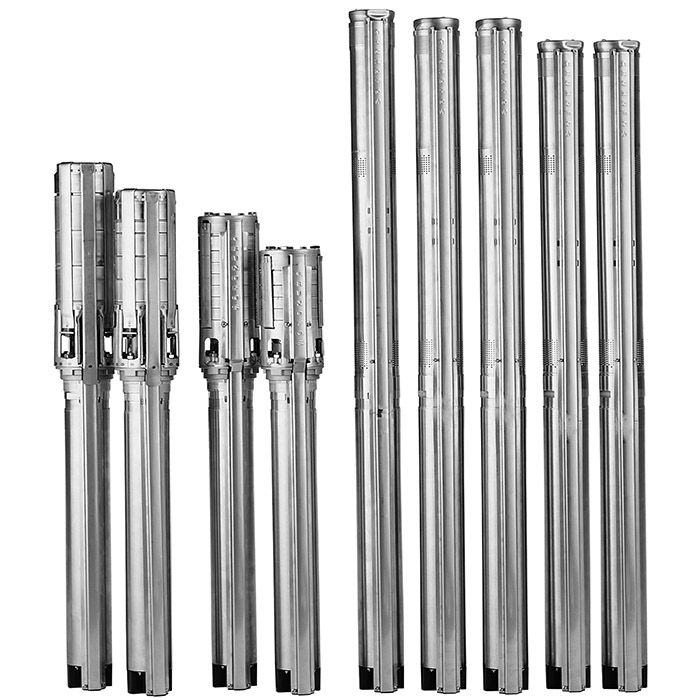 Grundfos SQFlex
Helical rotor, up to 250 m head, starts on minimal sunlight
Grundfos SQFlex
Helical rotor, up to 250 m head, starts on minimal sunlight
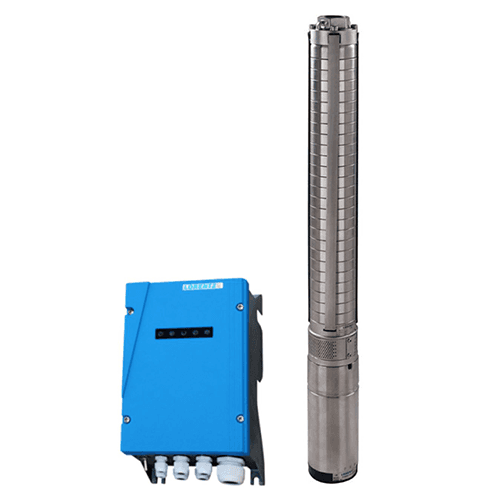 LORENTZ PS2-4000
The 70 m³ per day class for multi-paddock watering networks
LORENTZ PS2-4000
The 70 m³ per day class for multi-paddock watering networks
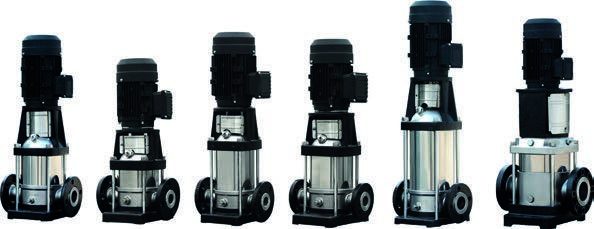 LORENTZ PS2 surface
Boost and transfer from ponds, rivers and tanks
LORENTZ PS2 surface
Boost and transfer from ponds, rivers and tanks
Frequently asked questions
How much water does a herd need?
Manufacturer reference figures: 68 to 155 litres per day for a dairy cow in milk, 50 litres for a cow with calf, 36 to 50 litres for two-year-old cattle, and 4 to 10.5 litres for sheep depending on status. Multiply by the head count, add a margin for your climate, and size the tank for two to three days of that demand. We refine this with you during the sizing.
My borehole is weak. Can solar still work?
Often better than any alternative. A low-flow helical rotor pump draws gently all day instead of hammering the well in short bursts, and the dry-running electrode protects the pump if the level dips. The tank accumulates the slow flow into a full day's supply.
What happens during a week of bad weather?
The tank is the answer: sized for two to three days, it bridges normal overcast spells, and the pump keeps producing at reduced flow under clouds. For regions with long dark seasons, a generator changeover or a wind variant of the system covers the gap.
Can the trough overflow at night?
No. The tank stops filling when its level switch trips, and the trough itself is fed through a float valve. Both controls are mechanical or low-power electronics included in the system design.
Water on every paddock
Tell us your herd size, borehole depth and location. We return a complete solar watering kit, from pump to float switch, with a wholesale quote.
Launch LE LAB Free sizing study