
How to size a solar water pump
Sizing makes or breaks a solar pumping project. An oversized pump wastes capital on panels it rarely uses; an undersized one leaves a tank empty in the dry season. The good news: three input values decide almost everything. This guide walks through them with a worked example, so you know exactly what data to collect before asking for a quote.
Head × daily demand × location
Total dynamic head (m), water demand (m³/day) and the solar irradiation at the site: with these three numbers, a complete system can be sized, from the pump model down to the number of panels.
Input 1: total dynamic head
The total dynamic head (TDH) is everything the pump must overcome, expressed in metres. It adds up five components:
- Static water level: depth from ground level down to the water table at rest.
- Drawdown: how far the level drops once pumping starts, measured during the borehole yield test.
- Elevation lift: height from the wellhead up to the tank inlet or the highest outlet.
- Friction losses: resistance of pipes, elbows and valves, which grows quickly with long or undersized pipelines.
- Application pressure: the pressure your equipment needs at the end of the line, for example for sprinklers or drip filters. 1 bar equals roughly 10 m of head.
A worked example from the Grundfos irrigation handbook: a borehole with a 50 m static level, 3 m of drawdown, 20 m of elevation to the tank, 25 m of calculated friction losses and 5 m of application pressure needs a pump sized for 5 + 25 + 20 + 50 + 3 = 103 m of head. Skip the friction term and the system will visibly underdeliver.
Input 2: daily demand in m³ per day
Grid-powered pumps are sized in m³ per hour. Solar pumps are sized in m³ per day, because the available power follows the sun: little at 8 am, maximum at noon, nothing at night. The realistic question is therefore how much water the system must deliver over a full solar day, in the worst month you still need water.
Estimate demand from the application: household and village consumption per person, herd size for livestock watering, or crop water requirement per hectare for irrigation. Then add the tank as a buffer, typically one to three days of demand, to ride through overcast spells.
Input 3: the sun at your location
The same pump with the same array delivers different daily volumes in Senegal, Chile or Indonesia. Sizing uses the local solar irradiation, expressed in kWh/m² per day on the tilted panel plane. Manufacturer performance curves are typically published for a reference of 6 kWh/m² per day; a professional sizing corrects this for your latitude, the tilt angle and the seasonal profile, and selects the array so the worst irrigation month is still covered.
Size your system in two minutes
LE LAB applies this exact method for you: enter your daily water need, the depth and your location, and get the recommended pump, controller and PV power for your site. Free, no account required.
Reading a solar pump curve
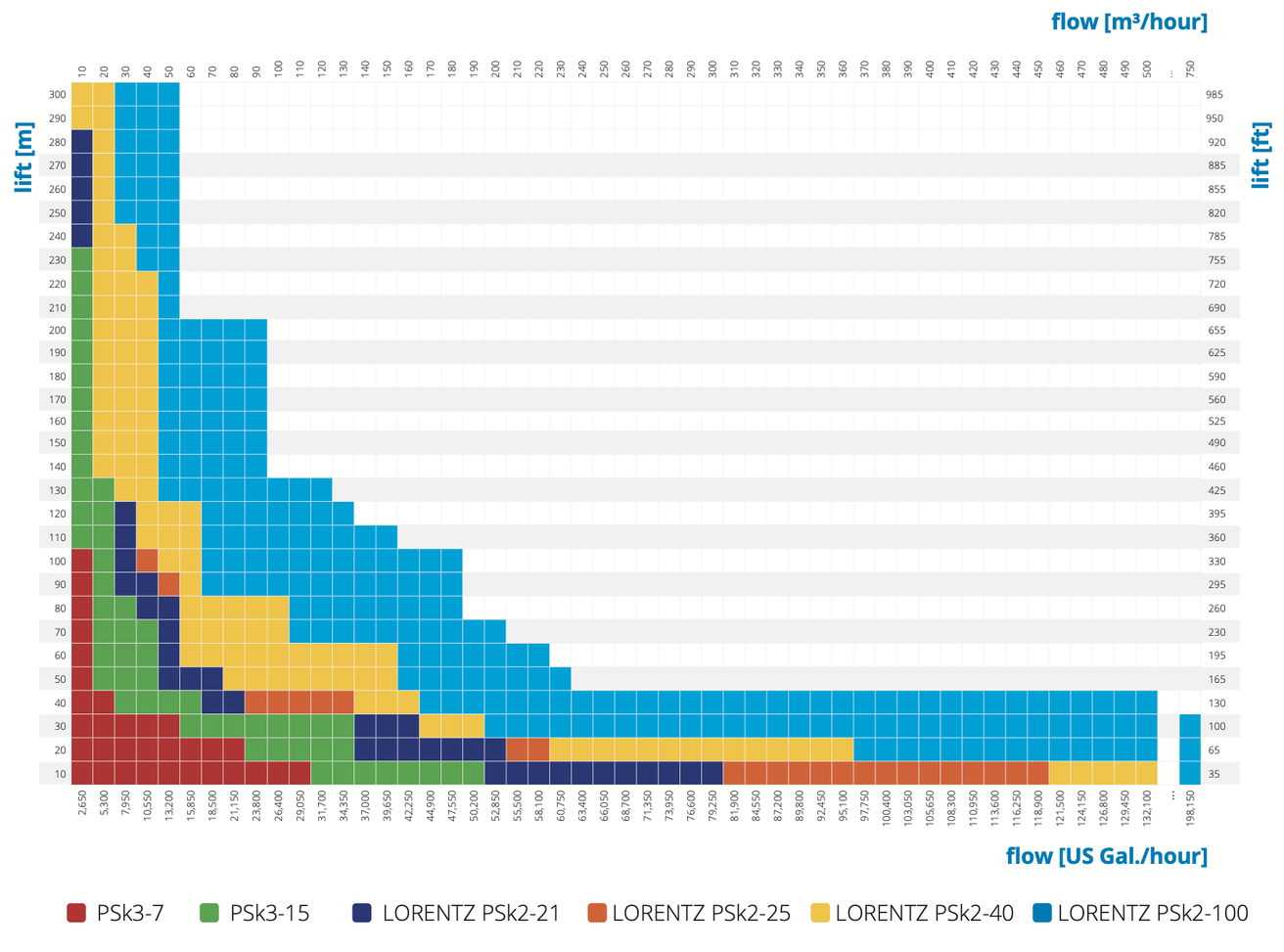
Solar pump documentation shows families of curves: daily volume against head, one curve per array power. Once your TDH and daily demand are fixed, the chart tells you which pump model and what array power in watt-peak reach the duty point. When the duty point lands between two models, choose the one above it: the small reserve costs little and protects the delivery in poor weather.
Why oversizing is a real problem
Water supply pumps are commonly oversized "to be safe". On solar systems this habit is expensive twice: the bigger pump costs more, and it demands a bigger array to reach its efficient operating zone. A correctly sized system is not a compromise, it is the configuration that delivers the requested volume at the lowest total cost. This is why serious suppliers size from data rather than from catalogue habit.
Check the water, not just the numbers
The pumped liquid has its own limits, and ignoring them shortens pump life dramatically:
| Parameter | Typical limit (stainless steel submersibles) |
|---|---|
| Sand content | 50 g/m³ maximum; more reduces pump lifespan considerably |
| pH value | 5 to 9 |
| Liquid temperature | 0 to 40 °C |
| Chlorides | up to 300 ppm for standard AISI 304, up to 500 ppm for AISI 316; zinc anodes beyond |
High sand content calls for proper well development and a flow sleeve; brackish water calls for the 316 stainless variant. These checks belong in the sizing, not in the warranty claim.
From three numbers to a complete kit
A finished sizing is more than a pump reference. The bill of materials includes the pump and motor, the controller or solar pump inverter, the array with its mounting structure, the drop cable and its termination kit, the level or pressure switches, and the protections. SINES Export returns exactly that: send us your three inputs and the borehole report, and our team sizes the full system on Grundfos SQFlex, SP with RSI inverter or LORENTZ PS2, with a wholesale quote.
Reference equipment
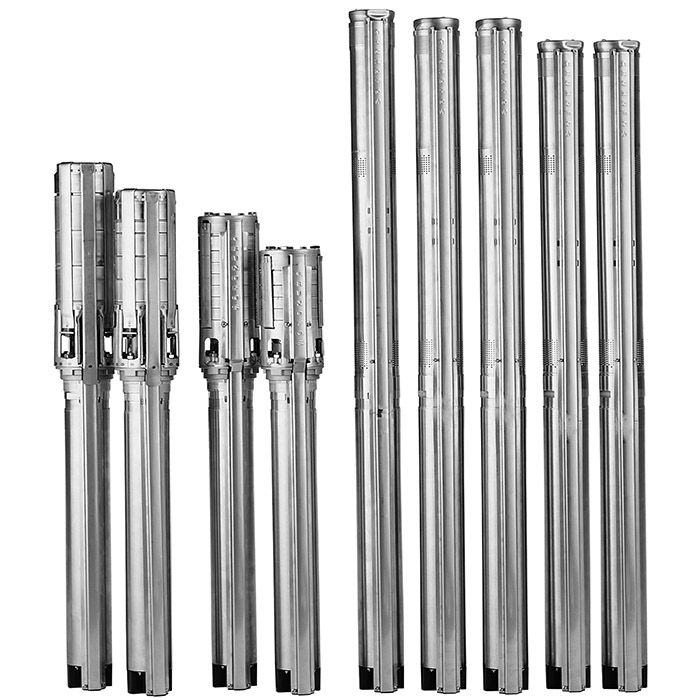 Grundfos SQFlex
Boreholes up to 250 m head, integrated MPPT electronics
Grundfos SQFlex
Boreholes up to 250 m head, integrated MPPT electronics
 Grundfos SP
High-yield boreholes, stainless steel, driven by a solar inverter
Grundfos SP
High-yield boreholes, stainless steel, driven by a solar inverter
 Grundfos RSI
Solar inverter 1.5 to 250 kW for SP and CR pumps
Grundfos RSI
Solar inverter 1.5 to 250 kW for SP and CR pumps
Frequently asked questions
How many solar panels does a water pump need?
It depends on the three inputs above. As a real-world reference, a documented village system lifts water from 40 m and delivers up to 5,000 litres per day with a 900 W array. Double the head and you roughly double the energy each cubic metre requires.
What borehole data should I send for a sizing?
The drilling report if you have it, otherwise: borehole depth and diameter, static water level, drawdown and tested yield, pipe length and diameter to the tank, tank elevation, and your daily demand. Location (nearest town or coordinates) completes the picture.
My duty point falls between two pump models. Which one?
Select the model whose curve passes just above your duty point. The reserve keeps the daily volume safe in less favourable weather, and it has no practical downside for the system efficiency.
Is the sizing service really free?
Yes. Our team sizes solar pumping systems every day for installers, EPC contractors and NGOs, and returns the complete bill of materials with the wholesale quote. See our technical studies service.
Send us your three numbers
Head, daily demand, location. Our team returns the sized system with the complete bill of materials and a wholesale quote, fast.
Launch LE LAB Free sizing study