
Sprinkler and pivot irrigation on solar power
Sprinklers and centre pivots irrigate the crops that drip cannot economically cover: cereals, fodder, pasture, and any dense field crop. They demand more pressure and more instantaneous flow than drip, which changes the solar architecture: bigger pumps, external solar inverters, and often a hybrid power scheme. Here is how they are built.
Sprinklers: pressure is the design driver
A sprinkler throws water through the air, and the throw costs pressure: nozzles typically operate from around 2 bar for low-pressure spray heads to well beyond 4 bar for impact sprinklers and travelling guns. Add pipe friction and elevation, and the pump quickly needs several times the head of a drip system for the same field.
Uniformity rules the layout. Sprinkler spacing is designed so the wetted circles overlap, and wind distorts those circles: fixed systems compensate with tighter spacing, while droplet size is a trade-off of its own, since fine droplets drift in the wind and heavy droplets can damage delicate crops and cap fragile soils.
Pivots: steady flow over long days
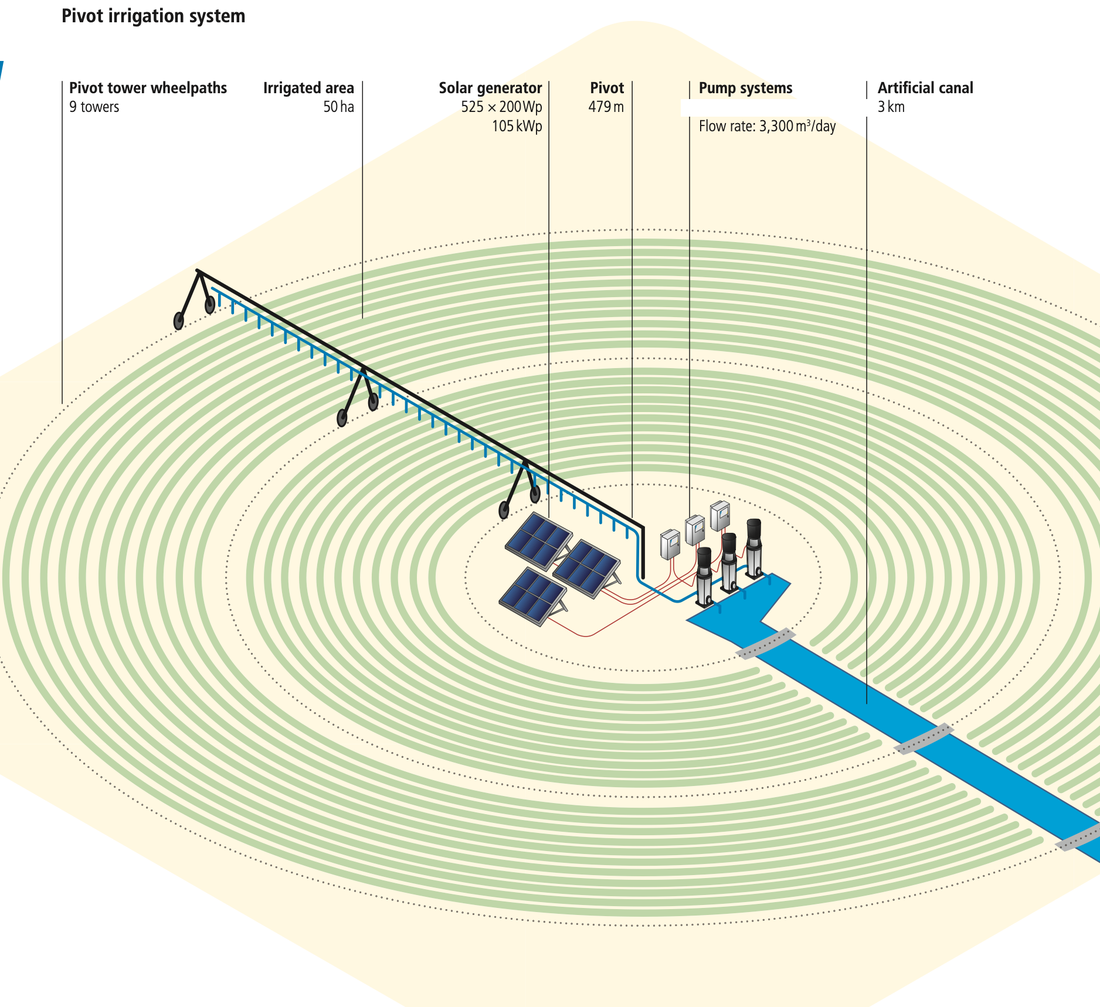
A centre pivot is the most uniform way to irrigate large circles of field crops, and it is a pressurised machine by nature: the span needs constant pressure at the last tower to keep its sprinkler package accurate. Pivots therefore pair with pumps that hold a stable duty point for hours, which on solar means a properly sized array with an inverter that manages the transition through clouds, or a hybrid scheme where the grid or a generator carries the night shift.
The solar architecture for big pressure
Above the reach of compact solar pumps, the standard architecture is a three-phase pump driven by an external solar pump inverter with MPPT:
- From boreholes: a Grundfos SP submersible, all stainless steel, sized on the borehole yield.
- From canals, reservoirs and rivers: a Grundfos CR multistage surface pump as the pressure stage.
- The drive: a Grundfos RSI from 1.5 to 250 kW, with the enclosure rating depending on the version, or an ABB ACQ80 for custom configurations. Both convert the array's DC into the variable three-phase supply the motor needs, harvesting maximum power as the light changes.
The same drives accept AC input, so the pivot can run on grid or generator when the schedule demands it, with solar carrying the daytime load. On many commercial farms this hybrid operation is the whole business case: the array pays for itself against the daytime energy bill while the machine keeps its 24-hour capability.
And traditional flood irrigation?
Flood and furrow irrigation still water a large share of the world's fields, essentially for free where gravity does the distribution. Solar pumping enters that picture upstream: lifting water from the borehole or the river into the canal or the basin. A simple tank-and-gravity system often modernises a flood scheme at minimal cost, before any pressurised hardware is considered.
Reference equipment
 Grundfos SP
Stainless steel borehole pumps for high-yield wells
Grundfos SP
Stainless steel borehole pumps for high-yield wells
 Grundfos RSI
Solar inverter 1.5 to 250 kW, MPPT
Grundfos RSI
Solar inverter 1.5 to 250 kW, MPPT
 Grundfos CR
Multistage pressure stage for sprinkler and pivot stations
Grundfos CR
Multistage pressure stage for sprinkler and pivot stations
Frequently asked questions
Can a centre pivot run entirely on solar?
Yes, with an array sized for the pivot's flow and pressure over the irrigation season. Most commercial installations choose a hybrid setup instead: solar carries the daytime load, grid or generator covers night sets and exceptional weeks. The inverter switches sources cleanly either way.
What pressure do sprinklers need?
It depends on the hardware: low-pressure spray packages start around 2 bar at the nozzle, impact sprinklers and travelling guns demand substantially more, plus friction and elevation upstream. The pressure target drives the pump selection, which is why we size from your sprinkler package, not from the field area alone.
Impact sprinklers or spray heads?
Impact sprinklers throw further and tolerate dirty water better; spray heads run at lower pressure, which suits solar arrays. Wind, crop fragility and soil capping enter the choice too. Both work on solar power once the pressure demand is in the sizing.
Can I keep my grid connection?
Yes. The solar pump inverters we supply accept AC input as well as the array's DC, so the station uses the sun when it shines and the grid when it does not. The array then simply offsets your daytime energy bill.
Sizing a pressurised irrigation station?
Send us the sprinkler package or pivot specification, the water source and the field elevation. We return the pump, inverter and array sized together, with a wholesale quote.
Launch LE LAB Free sizing study