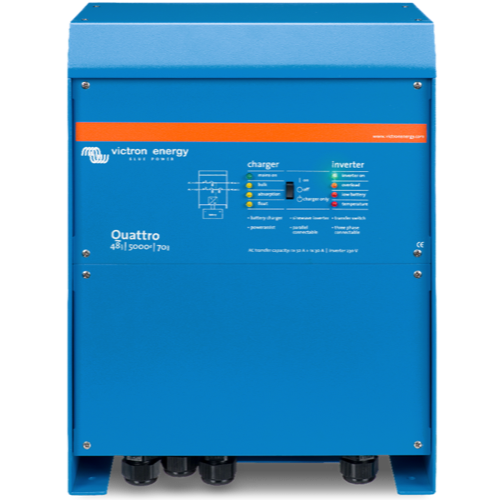
Two AC inputs with integrated transfer switch
The Quattro can be connected to two independent AC sources, for example the public grid and a generator, or two generators. It automatically connects to the active source.
Two AC outputs
The main output has no-break functionality: in the event of a grid failure, or when shore or generator power is disconnected, the Quattro takes over the supply to the connected loads. This happens so fast (less than 20 milliseconds) that computers and other electronic equipment continue to operate without disruption. The second output is live only when AC is available on one of the inputs of the Quattro; loads that should not discharge the battery, such as a water heater, can be connected to it.
Three-phase, parallel and split-phase operation
Three units can be configured for a three-phase output, and up to 4 sets of three 15 kVA units can be connected in parallel to provide 144 kW / 180 kVA of inverter power and 2400 A of charging capacity. A split-phase supply can be obtained by connecting the Victron autotransformer to a unit programmed to supply 240 V / 60 Hz.
PowerControl – dealing with limited generator, shore or grid power
The Quattro is a very powerful battery charger and can draw a lot of current from the generator or shore supply (16 A per 5 kVA Quattro at 230 VAC). A current limit can be set on each AC input: the Quattro then takes the other AC loads into account and uses only the spare current for charging, preventing the generator or mains supply from being overloaded.
PowerAssist – boosting shore or generator power
PowerAssist allows the Quattro to supplement the capacity of the AC source. Where peak power is required only for a limited period, insufficient mains or generator power is immediately compensated by power from the battery; when the load reduces, the spare power is used to recharge the battery.
Solar energy: AC power available even during a grid failure
The Quattro can be used in off-grid as well as grid-connected PV and other alternative energy systems. Loss-of-mains detection software is available.
System configuration
In stand-alone applications, settings can be changed in a matter of minutes with a DIP switch procedure. Parallel and three-phase systems are configured with the VE.Bus Quick Configure and VE.Bus System Configurator software, and off-grid, grid-interactive and self-consumption applications involving grid-tie inverters and/or MPPT solar chargers are configured with Assistants.
On-site and remote monitoring
On site, the Quattro can be monitored and controlled with a battery monitor, the Digital Multi Control Panel, a Cerbo GX or another GX device, a smartphone or tablet (Bluetooth Smart) or a laptop or computer (USB or RS232). With a Cerbo GX or another GX device, data can be stored and displayed on the VRM (Victron Remote Management) website, and settings can be changed remotely when the system is connected to the Ethernet.
Main technical data (official datasheet, 230 V models)
• Battery: 12 V, 24 V or 48 V depending on the model; DC input voltage range 9,5 – 17 V, 19 – 33 V or 38 – 60 V
• AC inputs (2x): input voltage range 187-250 VAC, input frequency 50/60 Hz; maximum feed through current 2x 50 A (3000 VA models) or 2x100 A (5000 to 15000 VA models)
• Output: 230 VAC ± 2 %, 50 Hz ± 0,1 % (can be adjusted to 60 Hz)
• Continuous output power at 25 °C: 3000, 5000, 8000, 10000 and 15000 VA, i.e. 2400, 4000, 6400, 8000 and 12000 W
• Peak power: 6000, 10000, 16000, 20000 and 25000 W
• Charger: absorption 14,4 / 28,8 / 57,6 V, float 13,8 / 27,6 / 55,2 V; starter battery charge current 4 A (12 V and 24 V models only)
• Auxiliary output: 25 A (3000 VA models) or 50 A (5000 to 15000 VA models); 3 programmable relays
• Enclosure: aluminium (blue RAL 5012), IP20; operating temperature -20 to +60 °C