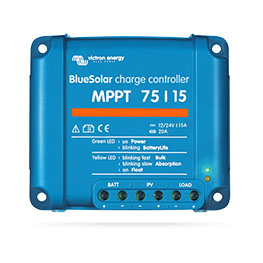
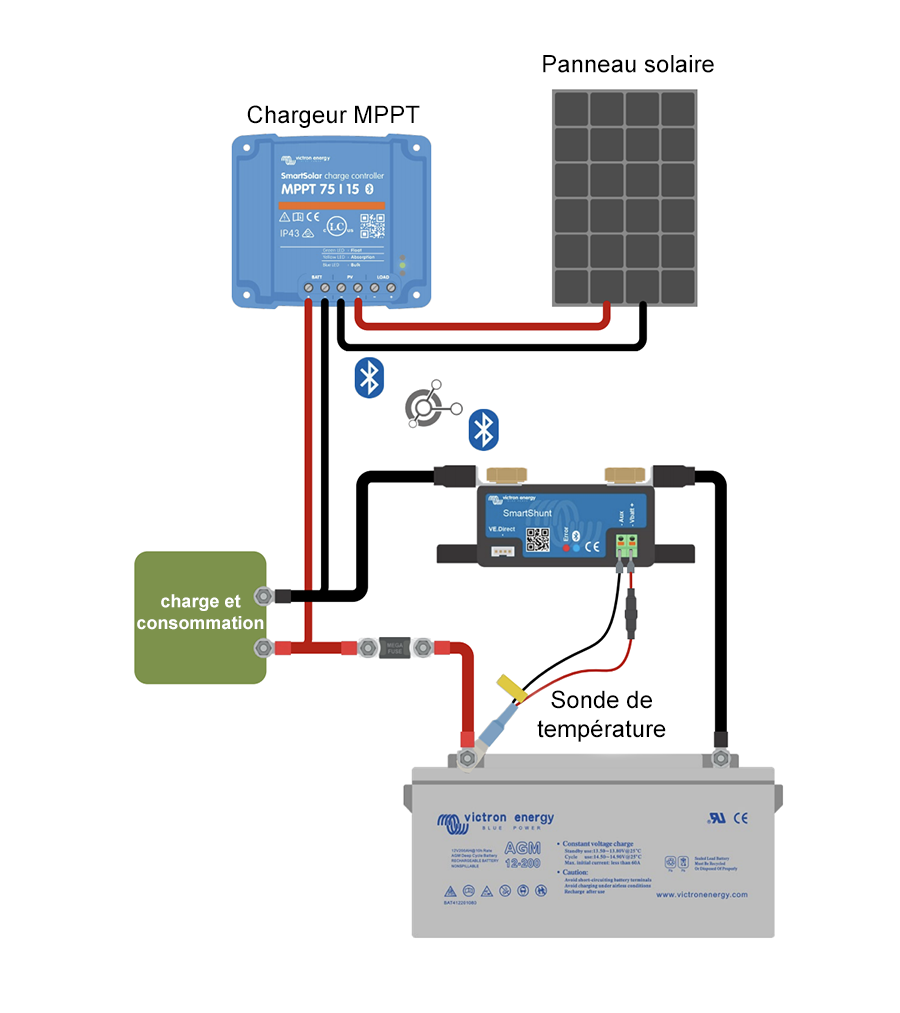
Built-in Bluetooth on the SmartSolar models
The SmartSolar MPPT chargers can be monitored and configured over Bluetooth from the VictronConnect app. This lets you set up the unit, manage it and read data at a glance, for example battery voltage and current, PV voltage and current, and historical data. With the BlueSolar version, an optional Bluetooth dongle is required. With an optional VE.Direct Bluetooth Smart dongle, the BlueSolar products can also be configured from a smartphone.
Maximum PV array power according to system voltage
| | PV power for a 12 V battery voltage | PV power for a 24 V battery voltage | PV power for a 48 V battery voltage |
|---|
BlueSolar MPPT 75/10
SmartSolar MPPT 75/10 | 145 Wp | 290 Wp | - |
BlueSolar MPPT 75/15
SmartSolar MPPT 75/15 | 220 Wp | 440 Wp | - |
BlueSolar MPPT 100/15
SmartSolar MPPT 100/15 | 220 Wp | 440 Wp | - |
BlueSolar MPPT 100/20
SmartSolar MPPT 100/20 | 290 Wp | 580 Wp | 1160 Wp |
Automatic battery voltage recognition
Victron MPPT solar chargers automatically adjust to the battery voltage. The 100/20 model is designed to operate in 12, 24 or 48 V systems. The 75/10, 75/15 and 100/15 versions operate in 12 or 24 V only.
Ultra-fast Maximum Power Point Tracking (MPPT)
Especially in cloudy conditions, when the light intensity changes constantly, an ultra-fast MPPT controller improves energy harvest by up to 30 % compared with PWM (Pulse Width Modulation) charge controllers, and by up to 10 % compared with slower MPPT controllers.
Advanced Maximum Power Point detection in case of partial shading
In the event of partial shading, two or more maximum power points may be present on the power-voltage curve. Conventional MPPTs tend to lock onto a local MPP, which may not be the optimum MPP. The innovative SmartSolar algorithm always maximises energy harvest by locking onto the optimum MPP.
BatteryLife: intelligent battery management
When a solar charge controller cannot fully recharge the battery within one day, the result is often that the battery is constantly switching between a « partially charged » state and an « end of discharge » state. This mode of operation (with no regular full recharge) will destroy a lead-acid battery within weeks or months. The BatteryLife algorithm monitors the battery state of charge and, where necessary, raises the load disconnect level slightly day by day (i.e. it disconnects the load earlier) until the harvested solar energy is sufficient to recharge the battery to almost 100 % of its capacity. From that point on, the load disconnect level is modulated so that a recharge of close to 100 % is reached at least once a week.
Load output
Excessive battery discharge can be prevented by connecting all loads to the load output of your solar controller. The load output disconnects the loads when the battery reaches a predetermined voltage. The load output is short-circuit protected. Higher-power loads, such as inverters, must be connected directly to the battery; the inverter's remote control input is then wired to the load output.

Remote monitoring and control
When combined with a GX device (for example a Cerbo GX), you can monitor and control your MPPT charge controller and your system either locally (LAN) or remotely over the internet from anywhere in the world, through the free VRM app and the free VRM website. You can access it from a phone, tablet, laptop or PC running various operating systems. The level of control over your system is unlimited, whether to adjust settings on your Multi or to start your back-up generator automatically, and much more.